Saturday, June 28, 2008

Diving with the Turtles at Honaunau

I recently went SCUBA Diving with the Hawaiian Green Sea Turtles at Honaunau Bay (Place of Refuge), South Kona on the Big Island. This is one of my favorite places to dive on the Big Island and offers an expansive reef in relatively shallow water (that means a lot of bottom time!) The quality of the reef is excellent with a variety of different types and colors of mature coral that stretches out and around the bay. The visibility is usually typical Kona (excellent) - although on this particular stormy day it wasn't its usual 100' of clarity. Also, one added bonus - you are pretty much guaranteed to swim with some turtles!

This spot is popular with snorkelers too (if they can figure out the directions). The area closest to shore is shallow and offers exceptional snorkeling. The entry point is right off of a lava rock shelf. As popular a site as this is - if no one was in the water you would probably drive right by as it is a non-descript bend in the road.


Friday, June 20, 2008

Video - Kayaking to Makalawena

Here is a video clip of us kayaking onto Makalawena Beach - there were a few minor swells and rollers, luckily the arrival area was an empty sandy beach with no obstacles... Also, I forgot to mention that we kayaked next to a pod of Spinner Dolphoins on the way back to Kua Bay - it was quite memorable.

Wednesday, June 18, 2008

Kayak to Makalawena Beach

This morning we put in our Kayaks at Kua Bay (Maniniowali Beach) right as the park opened up at 9:00 AM. On board we had our snorkeling gear, our waterproof cameras and a cooler with kalua pig sandwiches inside. Our goal was to kayak to Makalawena Beach - a secluded and austere beach that is difficult to access. We talked about attempting this a while ago in a previous blog post but were unsuccessful - today we were determined to do it! Luckily, the weather smiled upon us with calm seas and sunshine. So, we loaded our kayak and carried it down over the rocks from the pavement to the bleached-white sandy beach below and started paddling.


Ahead and to the north there was already a dive boat anchored atop the reef nearby and our curiosity almost pulled us in that direction to investigate the diving conditions there - but we were focused on our goal of reaching Makalawena (many say this is the prettiest beach on the island...) We started paddling to the south and the scenery was spectacular. The waters of Kua Bay are many different shades of blue - from emerald to a light and bright blue, to a darker navy blue where the reef is below. We continued and passed the large mound of a hill to our left and noticed for the first time a row of houses near its base - I wonder, more vacation rentals - or perhaps exclusive beach bungalows for the rich and famous?

As we kept paddling beyond this cove, we began to see the strand of trees that borders the northern end of Makalawena and we knew we were not far. As we paddled, the waters were so clear that we could make out glimpses of the vast reef below us. On several occassions, I lowered myself into the water with a mask and snorkel to marvel at the underwater topography and corals - the reef was beautiful. By now, we could make out a glimpse of thegently sloping dunes at Makalawena. The sand there is a special shade of white and could be seen shining in the distance, surrounded by lava rocks and underbriush. As we stared at the beach we were dissappointed by seeing a few people already on the beach - we were hoping to be the only ones there...

As we approached the northen edge of the beach, we notice a very shallow reef shelf below us with vibrant yellow and blue hued colors. We decided to anchor the kayak and snorkel the reef below us. We dropped our anchor on a patch of sand at the bottom and saw a thriving reef below us in about 20 feet of water. We spent a short while snorkeling and free diving above the reef. Then we finally decided it was time to paddle in to shore - at Makalawena!

We navigated the approach avoiding lava rocks and a shallow reef and were pushed by surging waves the final distance onto the immacculate beach - we were finally there! The beach was better than I imagined and better than any piuctures could capture. The sand was perfect - soft, fine, and firm under our bare feet. The azure waters shined and the white sand contrasted starkly next to the dried lava rocks and surrounding green shrubbery. The waves lapped on shore on the beach and pounded the lava rocks sending sea spray into the air. Makalawena is actually three beach crescents located side by side to each other - we had landed on the center crescent. We spent some time exploring and photographing the beach and eventually sat on the lava rocks to enjoy our sandwiches before paddling back to Kua Bay. It was a wonderful day! Right now, my legs ache a bit because I forgot to add sunblock to them and they are a bit sun burnt...

Labels: , ,

Sunday, June 15, 2008

Trip to Kauai (Part 1)

I have just returned from a week to the island of Kauai. Although this website and blog are meant to concentrate on "all things Big Island", I will indulge you with a few musings and anecdotes from my trip to Kauai. In the near future, I will be posting detailed travelogues, photos, videos, and virtual tours about Kauai on a separate website...


When first arriving Lihue Airport I marveled as to how similar in layout and appearance it was to the Hilo Airport! On the arrival and landing, our plane came in low over the ridge (south of the airfield) and took a hard right descending turn to touchdown - it was pretty exciting and the (close up) view of the lushly vegetated mountains and rugged terrain was unbelievable. Kauai was a sight to behold.

My initial impression of the island was that it was very scenic and captured a lot of the feel from "Old Hawaii" - much like the eastern (Hilo) side of the Big Island does. Kauai has a lot of small towns with a few roads connecting inbetween - mostly one lane each way with a guaranteed view of the mountains from any spot on the island! There are a lot of white sand beaches on Kauai - some are small and hidden by dense foliage or palm trees, others are wide open long stretches of sand (several miles) lined with surfers enjoying a favorable break -- the beaches reminded me of many in Kohala on the Big Island, minus the dried lava fields. There are beaches on all four coasts of Kauai - however, the Western shore (Na Pali Coast) is nearly inaccessible...


The weather was as unpredictable as Hilo / Hamakua - with guaranteed early morning showers, and spotty rain here and there inbetween bright blue tropical skies. Without a doubt Kauai was very pretty - we wanted to stop our car nearly every mile on nearly every drive to take pictures of the scenery. Like I always tell my friends, Hawaii will turn anyone into a good photographer - and Kauai is no exception.

Labels:

Saturday, March 22, 2008

Kilauea Explosion - Portions of Park Closed

There was an explosion at the Halemaumau Crater, Kilauea Volcano, Hawaii Volcanoes National Park on 3/19/2008. Rocks shot from the Wednesday's explosion damaged a wooden fence that visitors used to peer into the crater and created hazards across nearby roads and paths.


Areas in the park that are shut because of explosive debris or high sulfur dioxide levels are:
• Crater Rim Drive between Kilauea Military Campsouth/southeast to Chain of Craters Road.
• Crater Rim Trail from Jaggar Museum parking lot south/southeast to Chain of Craters Road.
• All trails leading to Halema`uma`u crater are closed including those from Byron Ledge, 'Iliahi (Sandalwood) Trail, and Ka'u Desert Trail.
Rocks shot from the explosion damaged a wooden fence that visitors used to peer into the crater and created hazards across nearby roads and paths.


Excerpt from USA Today:

By Dave Dondoneau and Dan Nakaso, The Honolulu Advertiser
HONOLULU — Plumes of smoke billowed out of Kilauea volcano Thursday, and visitors were kept at least a mile away from the scene of the volcano's first explosion in 84 years.

Scientists who monitor instruments measuring activity at Kilauea volcano were surprised by the explosion that occurred at 2:58 a.m. Wednesday. The blast scattered boulders and smaller rocks over 75 acres of Hawaii Volcanoes National Park on the Big Island of Hawaii, said Steve Brantley, deputy scientist in charge of the U.S. Geological Survey's Hawaiian Volcano Observatory.
COMPLETE COVERAGE: Honolulu Advertiser

Scientists do not know whether — or when — a similar explosion will occur, Brantley said. There were no reported injuries, but falling rocks — including a boulder about 3½ feet in diameter — damaged the popular Halemaumau lookout and its parking lot. Rubble was scattered along Crater Rim Drive, the road that visitors use to drive through the park, Brantley said.
The explosion at Halemaumau crater was the first since 1924.

"There have not been any additional explosions since the one early Wednesday morning," Brantley said.

Scientists at the Hawaiian Volcano Observatory did not know what to expect in the coming days or weeks.

"It's very exciting for all of us," said Jim Gale, chief of interpretation at the observatory. "It's such a change from the overall activity I've seen in my seven years here.

"We're exploring new worlds," said Jim Kauahikaua, scientist-in-charge at the observatory. "The recent explosive event represents a significant addition and change to Kilauea volcano's ongoing activity, and the Hawaiian Volcano Observatory is using every means available to study its causes and consequences."

Gale said most of the park remains safe and open, but 1 mile of Crater Rim Drive was closed from Kilauea Military Camp to Jaggar Museum as a precaution.

Sulfur dioxide levels have been on the rise at Kilauea since December, Gale said. "There's enough sulfur dioxide being put out at the Kilauea summit right now to fill 150 Goodyear blimps a day," he added. "It is a concern."

The sulfur dioxide gasses pose a health risk, especially to people who suffer from asthma and chronic coughing, observatory geochemist Jeff Sutton said.

Fire and police authorities made emergency plans to evacuate nearby villages if the winds blew toxic gasses in their direction, said Duane Hosaka at Hawaii County Civil Defense. The volcano's gas emissions have moved toward the sea, rather than over populated areas.

One mile outside of Hawaii Volcanoes National Park, a handful of visitors canceled reservations at the 14-room Kilauea Lodge and Restaurant after inaccurate rumors spread that the park service was evacuating people after the explosion, said Janet Coney, the lodge's office manager. "They're not evacuating," Coney said.

"To me, there's a lot of excitement," she said. "I hope the mountain doesn't go. But with Mother Nature, you never know what could happen. You have to take one day at a time."

Sunday, March 9, 2008

Visitors Up Close with Kilauea Lava Flow

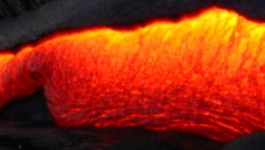
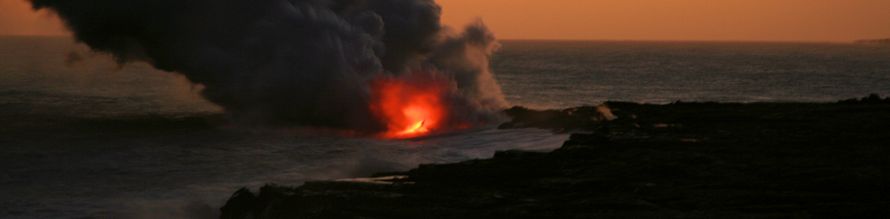
The saga of the Kilauea Volcano lava flow continues. Last year, the lava flow changed direction, flowing further east and through more remote areas - unfortunately preventing the general public from viewing the geological phenomenon. Since then, the lava flow threatened the edge of a few austere housing communities, but for the most part remained hidden from public view. But, in the last several days, the dynamic conditions changed yet again as the lava flow made a turn and presented a wonderful opportunity for tourists and locals alike to view the active lava flow's ocean entry - where the rivers of lava flow into the ocean resulting in plumes of steam, hissing of super-hot lava mixing with the roaring ocean waves.

Excerpt from KGMB Channel 9:

For some it was a once in a lifetime event, seeing lava flow into the Pacific Ocean from the Kilauea volcano. Saturday was the first time, visitors could legally get this close to the spectacular view. Big Island County opened a new viewing area or the public, and its just a quarter mile away from where the lava hits the sea.

Excerpt from KPUA AM670:

Viewing area to see lava flow opens
By Associated Press
HONOLULU (AP) _ A viewing area allowing people to see lava from Kilauea volcano flow into the water has opened. The site is accessible by a half-mile pedestrian trail and is a little more than a quarter mile from where the lava meets the sea. Officials expect hundreds of people to visit the site, which is the first way to legally see lava from the ground or watch it enter the sea since last June. State, county and federal officials say they will meet each morning to decide whether the lava flows threaten visitors and need to close the viewing area. Civil defense officials say they will have security at the site to prevent people from going there after hours. The site is open from 2 to 10 p.m.

This was the best re-cap of of how to view the latest lava flow:
Excerpt from the Honolulu Advertiser (3/7/08)

HILO, Hawai'i — Lava completed its trip down the slopes of Kilauea volcano and has begun flowing into the ocean, and Big Island officials braced for an expected surge of people visiting the remote Puna coastline to see Madame Pele's handiwork.

The area around the lava flow is still closed to the public, but state and county crews are expected to finish improving about two miles of rough access road today to provide a safe route to trails and observation points where spectators can see the lava.

A blessing and opening of the improved road and turnaround point are scheduled for tomorrow at 2 p.m., according to Big Island Mayor Harry Kim.

After inspecting the scene yesterday morning, Kim told his staff the latest flow offers a fascinating opportunity for visitors to view lava, but also poses risks.

The area has little or no cell phone service, almost no facilities and it will be easy for newcomers to become disoriented as they hike to get closer to the ocean entry, Kim said.

The visitor turnaround is being built in a forested area that was bypassed by previous flows, and another risk is that new fingers of lava could extend from a flow upslope of the access road and enter the old-growth area, starting fires and causing methane explosions as the lava reaches the vegetation, said Jim Kauahikaua, scientist-in-charge of the Hawaiian Volcanoes Observatory.

"There is a certainty of more fingers," and scientists will closely monitor the widening flow activity mauka of the improved road, Kauahikaua said. "It's expanding, so it will go east and west."

The lava began entering the ocean late Wednesday or early yesterday morning.

Kauahikaua said the pahoehoe flow is rapidly coating a bench extending off the coast, and is blasting steam into the air as it touches the seawater. He said there is a good chance a second finger of lava will continue downslope and by Saturday also will reach the ocean.

"It's really quite a spectacular sight, a lot of lava going into the ocean," he said.

ACROSS ROYAL GARDENS

The lava flow's passage through the Royal Gardens subdivision prompted Civil Defense to evacuate about five people from the area Monday as the flow threatened to sever an access road that the county built for lava viewing in 2001.

That road was cut Tuesday evening, and now state and county crews are working on a new turnaround further east to allow people to get close to the lava viewing area.

The flow passing through Royal Gardens offers the most accessible lava viewing opportunities from the ground in many months, and county officials expect 1,000 or more visitors a day will head for the new viewing site once it is opened.

Ted Miller, construction and maintenance superintendent for the state Department of Transportation's Highway Division on the Big Island, estimated the improvements are costing the state about $100,000.

More than a dozen state workers were operating graders, backhoes and other equipment to prepare the access road, which is made up of remnants of the old two-lane Highway 130 that was severed repeatedly by lava. The highway remnants are connected by narrow passages cut through lava that covered the highway.

The crews are improving the two-mile route, and adding a turnaround that will double as a helicopter landing area in emergencies, Miller said. Cars can park on the shoulder of the paved stretch, he said.

Traffic may be slow because the links between the paved areas are only one lane wide, forcing motorists to pull over to let one another pass, he said.

MAKING PEOPLE 'HAPPY'

The county in 2001 charged a toll for people who used a similar access road to get to the flow, and Kim said he may impose a similar charge again to recoup the cost of roadwork. Initially, however, there will be no charge to use the road, which will be open from 2 to 10 p.m.

"I think Madame Pele has given us a tremendous opportunity to admire her creation," Kim said.

"Even if this stops one day after it started, we're going to make a few hundred or a few thousand people happy," Kim said. "We're going to make a lot of people experience things that they've never even dreamt about."

Gov. Linda Lingle is expected to survey the flow tomorrow morning from a Hawai'i National Guard helicopter.

Labels: , ,

Monday, February 18, 2008

Visiting the Big Island Without a Car

Recently, friends of mine visited the Big Island of Hawaii. Naturally, I tried to help them plan their vacation - I offered tips on where to go, what hotel to stay at, and overall tried to steer them towards the http://www.letsgo-hawaii.com/ website for all of their vacation planning needs.

Unfortunately, I must have forgotten to mention that they would need a rental car (but, who goes on vacation without renting a car?)... Well, these friends arrived at Kona Keahole Airport without any plans for a car and then simply took a (very expensive) taxi to their hotel in Kailua-Kona town and began their vacation. Later on I did find out why they did this -- although they had never been to the Big Island, they had previously visited Oahu many times and were impressed with the robust public transportation system that exists there (namely the public bus) -- they thought the Big Island 1.) was smaller with attractions closer together and 2.) there was good public transportation. Wrong on both counts.

So, for the first several days all they did was venture a short walking distance from the Royal Kona Resort hotel on Alii Drive -- never even making it to the Kohala area beaches or Kahaluu Beach Park, or Captain Cook or South Kona -- because they did not have a vehicle. They remarked to me later, "There are no beaches on the Big Island!" - and I thought to myself, what a strange thing to say (until I realized they never even made it to the beach!) Eventually, for the last few days of their trip, they rented a car and drove to the Volcanoes National Park, Hilo, and then up the Hamakua Coast and back up over to Kona - probably the best part of their trip.

So, the moral of the story is - RENT A CAR on the Big Island. There is so much more to do and see and everything is so spread out compared to the other (smaller) islands. Rent a car (and pack some comfortable walking shoes) and you will be able to access all of the islands splendid attractions.

Labels: